Empty Counters: Why Employees Stop Using Office Cafeterias and How to Win Them Back
Introduction
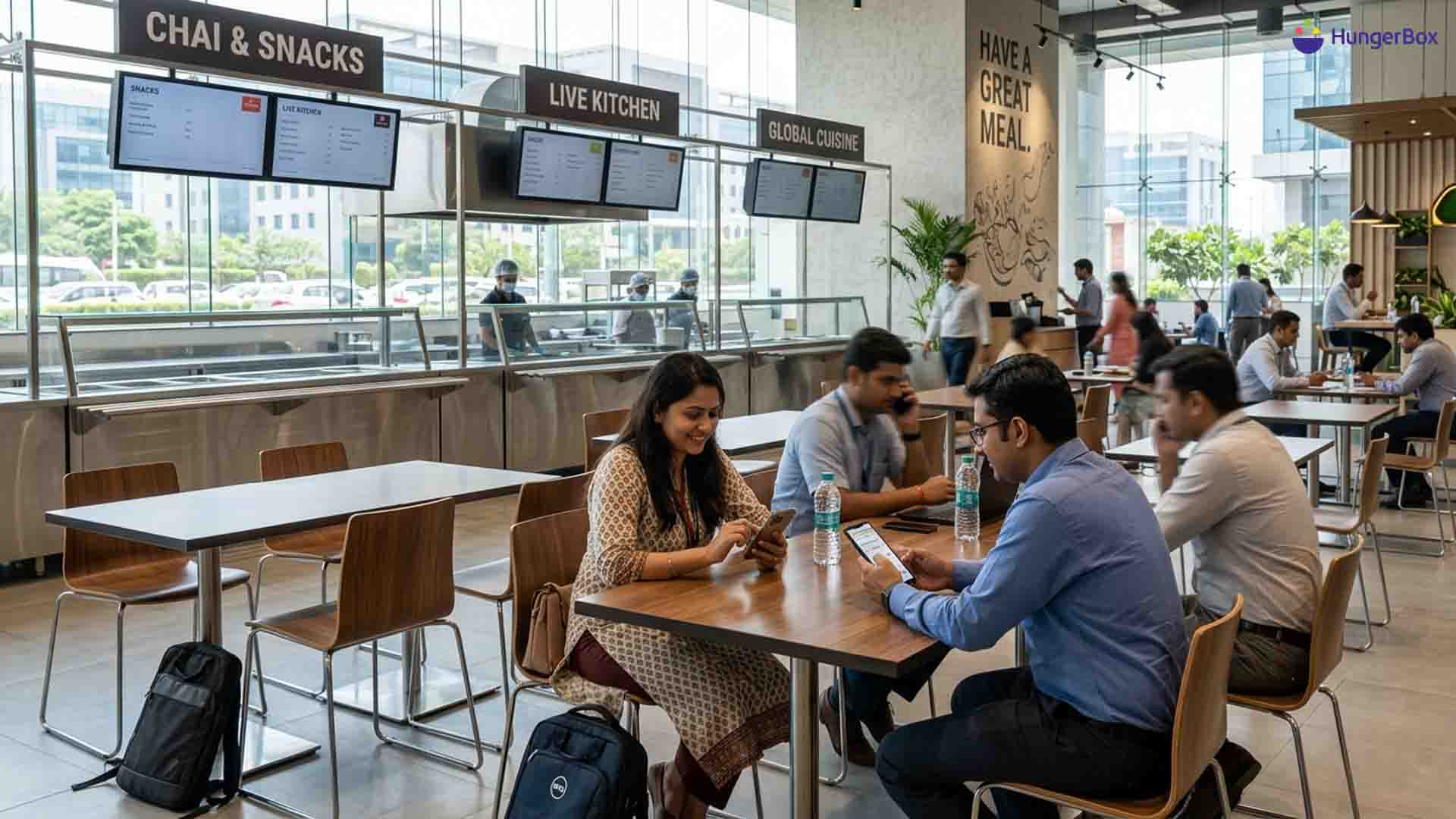
There is a specific kind of failure that does not show up in any operations review. The cafeteria runs on time. The vendor hits every SLA. Hygiene audits pass. And at 1 PM, three of the five counters are quiet, while a stack of delivery bags builds up at the security desk.
The company is subsidising food that employees are choosing not to eat.
This is the least-discussed problem in workplace dining, because nothing is visibly broken. But low adoption is expensive twice over — once in the subsidy spent on unused capacity, and again in the slow degradation it triggers in food quality. Understanding why employees drift away from office cafeterias, and what actually brings them back, starts with measuring the right thing.
Key Takeaways
- Total orders is a vanity metric. It cannot distinguish 400 loyal users from 1,200 occasional ones, and it hides decline for months.
- Repeat rate is the real health indicator. Adoption dies when people try the cafeteria and do not return, not when they never try it.
- Menu fatigue is the most common cause. A 14-day rotation feels varied in week one and repetitive by week four.
- Dietary exclusion silently removes whole segments. Jain, vegan, allergen-sensitive and high-protein eaters simply stop showing up.
- Feedback that goes nowhere accelerates the exit. An unanswered complaint teaches employees that the cafeteria is not fixable.
- Low adoption makes food worse, which lowers adoption further. Breaking that loop requires data, not a bigger subsidy.
The Adoption Metrics Most Offices Don't Track
Why total orders hides the problem
Most cafeteria reviews open with a monthly order count. That number can stay flat for a year while the underlying user base collapses 1,200 people ordering twice a month looks identical to 400 people ordering six times a month. One of those cafeterias is healthy. The other is being carried by a shrinking core of loyal users and is one menu change away from trouble.
The three numbers that actually matter
Unique users per month tells you reach, what share of headcount has used the cafeteria at all. Repeat rate tells you whether the experience survives contact with reality; if people try it once and do not come back, you have a product problem, not an awareness problem. Meals per employee per week tells you share of stomach — whether you are the default lunch or the fallback when someone forgets to order.
Track all three by site, and the diagnosis usually becomes obvious within a month.
Five Reasons Employees Stop Using the Office Cafeteria
1. Menu fatigue
The most common cause, and the most underestimated. A menu that cycles every 14 days feels generous in week one and predictable by week four. Employees eat lunch at work roughly 240 times a year; almost no menu is designed for that frequency. The drop-off is gradual, which is exactly why nobody catches it.
2. No options for how they eat
Jain, vegan, gluten-sensitive, allergen-avoidant, diabetic, high-protein, low-oil. Each group is a small percentage of headcount and collectively a large one. When someone scans the counter and finds nothing they can eat twice in a row, they stop scanning. They do not complain first — they just leave, and their absence is invisible because they were never counted.
3. The peak-hour experience
People will tolerate an average meal. They will not tolerate an average meal that costs them twenty-five minutes of queueing and a hunt for a seat. Congestion is one of the fastest ways to lose adoption, and it is a solvable operations problem rather than a food problem — covered in detail in why office cafeterias break at lunch hour.
4. Feedback that goes nowhere
A suggestion box, a WhatsApp group, an annual survey. Employees raise the same three issues repeatedly, nothing changes, and they conclude the cafeteria is not something anyone is managing. The complaint volume then drops — which admin teams sometimes read as improvement, when it is actually resignation.
5. Delivery apps have reset the benchmark
Employees now compare the cafeteria not against the previous caterer but against fifty restaurants on their phone, with ratings, filters, reorder history and a delivery promise. A single counter with a fixed menu and no way to see what is available before walking down is competing badly. The subsidy buys some tolerance, but not unlimited tolerance.
The Doom Loop: Low Adoption Makes the Food Worse
How thin volumes degrade quality
Caterers operate on volume. When adoption falls, revenue per counter falls, and the operator responds by trimming variety, using cheaper inputs, or reducing skilled kitchen staff. Food quality drops. More employees leave. Volumes fall further. Within two quarters, a cafeteria that had a menu problem now has a quality problem, and the vendor and the client are arguing about who caused it.
Why raising the subsidy doesn't break the loop
The instinct is to make the cafeteria cheaper. It rarely works, because price was not the reason people left. A deeper discount on food someone does not want to eat changes nothing, and it worsens the economics of the very contract you are trying to rescue. The loop only breaks when the reason for leaving is addressed directly.
A 90-Day Plan to Win Employees Back
Days 1–30: measure honestly
Establish unique users, repeat rate and meals per employee per week. Segment by floor, shift and department — decline is almost never uniform, and the pattern points at the cause. Add item-level order data so you can see which dishes carry the menu and which are dead weight.
Days 31–60: fix the menu with data, not opinion
Retire the bottom quartile of items by order volume and rating. Extend the rotation cycle so nothing repeats within three weeks. Add explicit dietary tracks — a reliable high-protein option, a genuine vegan option, clear allergen labelling — and make them visible in the app before employees walk down. Bring in additional food partners for cuisine variety rather than asking one caterer to be everything; a multi-partner cafeteria model is the structural fix for menu fatigue.
Days 61–90: close the feedback loop visibly
Move ratings into the ordering flow, where response rates are high, and route them to the vendor with consequences attached. Then publish what changed. "You rated this dish 2.1, we replaced it" is the single most effective adoption message a cafeteria can send, because it proves that feedback has somewhere to go.
What Healthy Adoption Looks Like
Targets vary by site type, shift pattern and how many external food options sit within walking distance. As indicative benchmarks for a single-site corporate office:
| Metric | Struggling | Healthy |
What it signals |
| Monthly unique users (% of headcount) | Under 40% | 65%+ | Reach |
| 30-day repeat rate | Under 30% | 55%+ | The experience holds up |
| Meals per employee per week | Under 1.5 | 3+ | Cafeteria is the default |
| Share of orders from top 10 items | Over 60% | Under 40% | Menu depth |
| Average item rating | Under 3.5 | 4.0+ | Food quality |
| Rated orders (% of total) | Under 5% | 20%+ | Employees believe feedback matters |
None of these can be collected from a manual counter. They come from transaction and rating data, which is one of the practical arguments for running a digital cafeteria platform rather than a purely managed service.
Your Cafeteria Is Competing Whether You Like It or Not
Every workplace cafeteria is now in a competitive market against every delivery app the employee has installed. That is not a reason for pessimism — the cafeteria has structural advantages in price, speed and proximity that no delivery service can match. But those advantages only matter if the food is worth walking down for.
HungerBox operates 891 cafeterias for 243 client organisations across 38 cities, with a network of 886 food partners and 1.44 million users placing over 13 million orders a month. That partner network exists precisely because variety is the hardest problem in workplace dining to solve with a single vendor.
More on this theme across our workplace dining articles, or browse the full HungerBox blog. It is also worth reading alongside where office cafeterias quietly lose money, since low adoption and cost leakage usually show up together.
If your counters are quieter than they should be, schedule a call with our team for an adoption assessment of your site, or contact us to discuss your cafeteria requirements.
Frequestly Asked Questions

As a working benchmark for a single-site corporate office, 65% or more of headcount using the cafeteria in a month, with a 30-day repeat rate above 55%, indicates a healthy operation. Sites with heavy hybrid attendance or many external food options nearby will run lower, so the trend line matters more than the absolute number.
Start by removing poor performers rather than adding items. Most cafeteria menus carry a long tail of dishes with low order volume and low ratings; retiring them and extending the rotation cycle increases perceived variety at no additional cost. After that, adding food partners is usually cheaper than asking one caterer to widen its repertoire.
Stated and revealed preferences diverge in every cafeteria, so build for both. Keep the popular items, make the healthier options genuinely good rather than dutiful, and put calorie and macro information in the ordering flow where the decision actually happens. Order data will tell you within a few weeks which healthy items are working and which are being ignored.