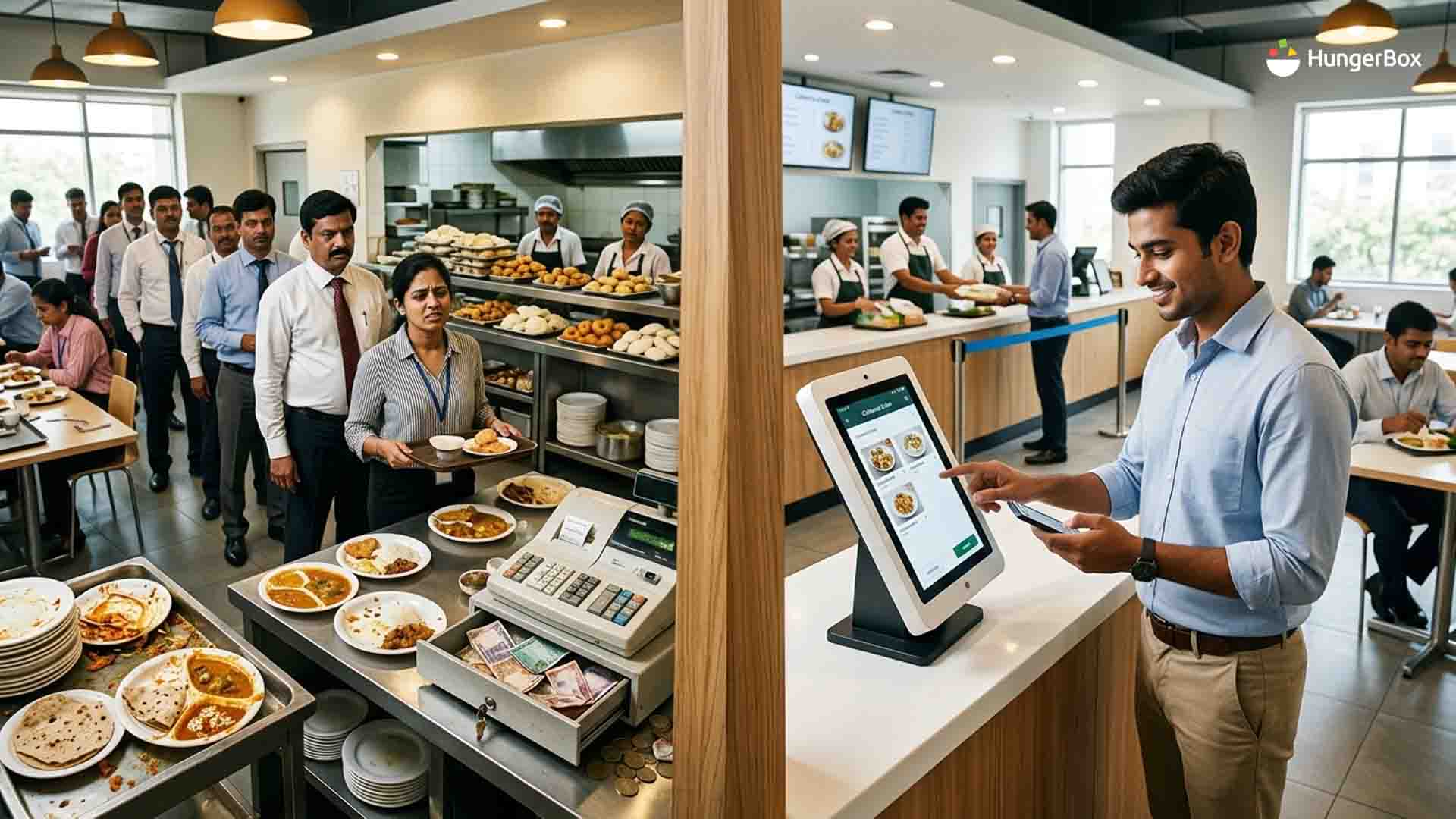
The Hidden Cost of Running Office Cafeterias: Subsidy Leakage, Overproduction and Unbilled Meals
Introduction
Most companies know exactly what they spend on real estate, power and housekeeping per employee. Very few can tell you what they spend on lunch.
Ask a facility head what a single meal costs the company and the answer usually arrives as a monthly number the vendor invoice, plus the subsidy, divided by nobody-is-quite-sure. That vagueness is expensive. Across large offices, IT parks and manufacturing campuses, office cafeterias leak a meaningful share of their food spend through ordinary operational blind spots rather than fraud: meals cooked that nobody ate, subsidies claimed by people not entitled to them, guest meals nobody billed, and reconciliation done on a spreadsheet three weeks after the fact.
This article breaks down where that money goes, why manual systems structurally cannot catch it, and what changes when the cafeteria is metered instead of estimated.
Key Takeaways
|
|
|
|
|
|
Why Office Cafeteria Costs Are So Hard to See
The vendor is both the service provider and the measuring instrument
Here is the uncomfortable arrangement in most office cafeterias. The caterer prepares the food, counts the plates served, records the headcount and submits the invoice. The company's admin team receives that invoice and approves it. At no point does the company generate an independent record of what was consumed.
This is not an accusation against caterers the vast majority are honest operators working on thin margins. It is a design flaw. When one party is both the service provider and the sole measurement instrument, errors only ever drift in one direction.
Small per-unit errors at enterprise volume
Cafeteria transactions are individually trivial and collectively enormous. A ₹6 discrepancy on 4,000 meals a day disappears completely inside a monthly invoice while costing over ₹70 lakh a year. Nothing in a manual process is designed to catch an error that small, and nothing in the approval chain is looking for one.
Five Places Office Cafeterias Quietly Lose Money
1. Subsidy without entitlement control
Most enterprises subsidise meals a fixed monthly wallet, a flat per-meal discount, or free meals for certain shifts and grades. In a manual cafeteria, entitlement is enforced by a person at a counter looking at an ID card.
That means contractors claim employee rates. Employees who have left the organisation continue to appear on the subsidy list because the cafeteria roster was never reconciled with the HRMS. Night-shift entitlements get claimed during day shifts. Nobody is running a scam; the control simply does not exist.
2. Overproduction and food waste
A caterer who runs out of biryani at 1:15 PM gets an escalation email. A caterer who throws away 200 portions gets nothing. So kitchens systematically over-prepare, and that buffer is priced into the contract.
Hybrid schedules have made this worse. Monday and Friday footfall in the same office can differ by 40%, yet indenting is often based on a static headcount figure agreed at contract signing. The cost of that gap sits somewhere either in wasted raw material or in a padded rate card.
3. Unbilled and untracked meals
Guest meals, interview candidates, client lunches, vendor staff, town halls, late-night crew meals for critical shifts. Each one is legitimate. Almost none of them are captured against a cost centre. At month-end these appear as a lump-sum "miscellaneous catering" line that no department owns, which means no department manages it down.
4. Menu and price drift
Contracts specify rates for a defined menu. Over eighteen months, portion sizes change, premium items get added at the counter, and specific items quietly move up a price band. Without item-level transaction data, drift is invisible until someone runs a comparison against the original annexure which usually happens only at renewal, if at all.
5. Manual reconciliation error
The final leak is simply arithmetic. Coupon books, manual registers, cash counters and end-of-day tallies produce numbers that are approximately right. Approximately right, multiplied by 90,000 transactions a month, is a meaningful number.
Why Manual Reconciliation Cannot Fix This
The instinct is to audit harder a monthly reconciliation meeting, a sample check of registers, a stricter approval process for the invoice. It does not work, for three reasons.
The data arrives too late
A discrepancy found on the 8th of next month cannot be corrected. The food is eaten, the shift is over, and the conversation becomes a negotiation rather than a correction.
The data is aggregated, not transactional
Registers record totals, not transactions. You can see that 3,800 meals were served on Tuesday. You cannot see which counter, which item, which employee, which entitlement or which cost centre so you cannot isolate the leak even when you know one exists.
The effort exceeds the recovery
Reconciling a large office cafeteria manually consumes days of admin time each month to recover an amount that may or may not exceed the cost of the exercise. So it gets skipped, and everyone agrees the invoice looks broadly reasonable.
What Actually Gets Metered When Office Cafeterias Go Digital
The shift is not from paper to app. It is from estimated to measured. A digital cafeteria platform creates a company-owned transaction record that exists independently of the vendor's count.
Item-level transaction records
Every order captured with counter, item, price, timestamp and user the raw material for every other control below.
Entitlement enforced at the point of sale
Subsidy applied automatically against live HRMS data, so a departed employee or a contractor on an employee rate becomes a structural impossibility rather than a counter-level judgement call.
Cost centre attribution
Guest meals, team lunches and event catering tagged to the department that consumed them, which turns an unowned lump sum into a managed line item.
Demand forecasting for indenting
Order history and pre-orders converted into production forecasts. This is the only reliable way to compress overproduction; AI-based food demand forecasting narrows the gap between what is cooked and what is sold.
Automated invoice reconciliation
The vendor invoice is validated against the company's own transaction log before payment, not after. The operational benefit of all this is convenience. The financial benefit is that the invoice becomes verifiable.
A Worked Example: What Cost Visibility Looks Like
Consider an illustrative 5,000-employee office running two counters and a beverage station.
|
The point of the table is not the specific numbers, which vary by site. It is the column headings. "Not measurable" and "unknown" are the actual line items being paid for in most office cafeterias.
Five Questions to Ask Before Signing Your Next Cafeteria Contract
- Who generates the consumption record you or the vendor? If the answer is the vendor, everything else is a matter of trust rather than control.
- Can you see cost per meal per employee, per site, today? Not last month. Today.
- How is subsidy entitlement enforced at the point of sale? If the answer involves someone checking an ID badge, the control is advisory.
- What is the measured gap between food produced and food sold? A vendor who cannot answer this is pricing the uncertainty into your rate.
- Are guest and event meals attributed to a cost centre? Unowned spend is unmanaged spend.
From a Cost Centre to a Controlled Cost
Office cafeterias will always be an expense. The question is whether it is an expense you can explain, defend at budget review and steadily optimise or a monthly number that arrives, gets approved and grows quietly.
HungerBox operates 891 cafeterias across 243 client organisations, processing over 13 million orders a month. That scale exists because every one of those orders is a data point the client owns: item-level, entitlement-checked, cost-centre tagged and reconciled before the invoice is paid.
If you are approving a cafeteria invoice this month without an independent record to check it against, that is the first thing worth fixing.
Talk to the HungerBox team about a cost and operations audit of your cafeteria or you can schedule a call with our experts, who can answer your questions and point you in the right direction.
Frequestly Asked Questions

It varies widely by site, contract model and headcount volatility, but the losses concentrate in four areas: overproduction against uncertain attendance, subsidy claimed by non-entitled users, unbilled guest and event meals, and manual reconciliation error. Sites with hybrid attendance patterns and no forecasting tend to see the widest gap between food produced and food sold.
Take the total monthly outflow vendor invoice plus company subsidy plus any directly borne costs such as utilities, consumables or cafeteria staff and divide it by the number of meals actually consumed, taken from a transaction record rather than a vendor headcount. The denominator is where most calculations go wrong.
Yes. Cost visibility is a technology layer, not a catering decision. A cafeteria management platform can sit over an incumbent vendor, giving the company its own consumption record while the caterer continues to operate. Many organisations start there and only revisit the vendor mix once they can see the numbers.