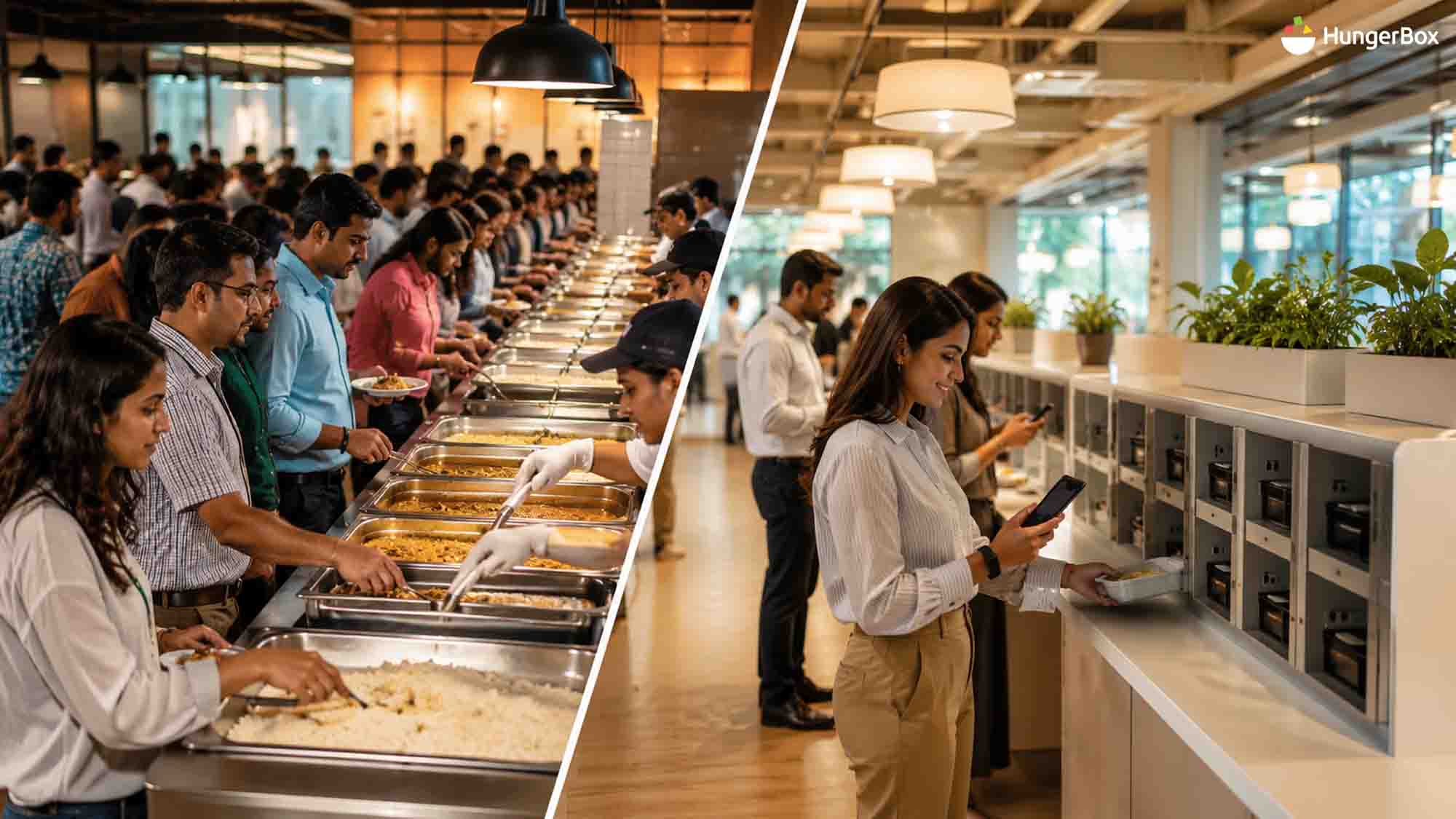
What is the Difference Between a Managed Catering Company and a Cafeteria Technology Platform?
If you run an office, IT park, or campus, you have probably heard both terms used for the same thing: managed catering company and cafeteria technology platform. They sound similar, but they are not the same. One is about people cooking and serving food. The other is about the technology and systems that run the entire cafeteria, from ordering to payments to reporting.
Many facility managers pick a vendor without understanding this difference, and later struggle with long queues, no real data on food waste, and no way to track vendor performance. This confusion gets more common as workplaces grow bigger and employees expect faster, more convenient food service.
A cafeteria technology platform is built to solve exactly this problem. It connects employees, kitchen staff, vendors, and facility managers on one system, so food service runs smoothly at any scale. It is not just about serving meals. It is about giving businesses control, visibility, and data over their entire cafeteria operation.
In this blog, we will explain what a managed catering company does, what a cafeteria technology platform does, how they are different, and how to decide which one your workplace actually needs.
What is a Managed Catering Company?
A managed catering company is a food service provider. They take care of cooking, serving, and running the cafeteria counter on a day-to-day basis. You hire them, and they bring their own chefs, staff, and kitchen operations to your office or campus.
This model has existed for decades and works well for basic food service. But it usually depends on manual processes: paper menus, cash or card payments at the counter, and little to no real-time data on what employees are eating or how much food is wasted.
How Managed Catering Works
- The catering company signs a contract with your business
- They set up a kitchen and serving counter on your premises
- Staff prepare and serve food during meal hours
- Payments are often collected manually or through basic POS systems
- Menu planning and quality checks are handled internally by the vendor
The focus here is on food preparation and service. Technology, if used at all, is usually limited to billing.
What is a Cafeteria Technology Platform?
A cafeteria technology platform is a digital system that manages the entire cafeteria experience, not just the food. It connects apps for employees, dashboards for facility managers, and tools for vendors and kitchen staff, all in one place.
Instead of replacing the food vendors, a cafeteria technology platform usually works with them, or with multiple vendors, and adds the technology layer on top. This gives businesses one system to manage ordering, payments, hygiene checks, vendor performance, and reporting, even across multiple locations.
How a Cafeteria Technology Platform Works
- Employees order meals through a mobile app, QR code, or kiosk
- Payments happen digitally through wallets, meal cards, or subsidised credits
- Kitchen and vendor apps manage order flow and preparation
- Facility managers get a dashboard with real-time data on sales, footfall, and feedback
- Multiple cafeterias or vendors can be managed from a single system
The focus here is on control, data, and convenience, along with the food itself.
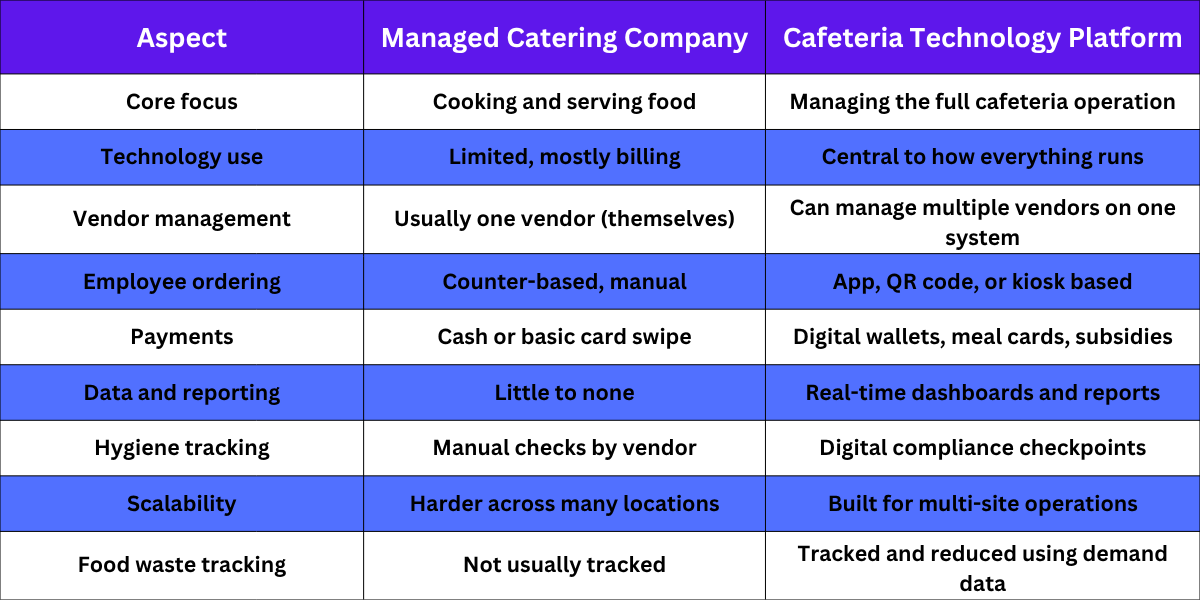
Key Differences Between a Managed Catering Company and a Cafeteria Technology Platform
Which One Does Your Business Need?
If you run a small office with one cafeteria and simple needs, a managed catering company alone might be enough for basic food service.
But if your business has grown, has multiple cafeterias, multiple vendors, or employees who expect a faster and more convenient way to order food, a cafeteria technology platform becomes necessary. It does not remove the food vendor from the picture; it simply gives you the tools to manage everything better, with less manual work and more visibility.
Many large offices, IT parks, and campuses now use a cafeteria technology platform to bring structure to what used to be a manual, hard-to-track process.
Why Companies Are Moving to Cafeteria Technology Platforms
- Employees save time with pre-ordering and skip long queues
- Facility managers get real-time reports instead of guesswork
- Food waste drops because ordering data helps predict demand
- Vendor billing disputes reduce since everything is tracked digitally
- Hygiene and compliance checks happen consistently, not occasionally
- Multiple cafeterias across cities can be managed from one dashboard
This shift is not about removing the human side of food service. It is about adding the missing layer of control and data that manual catering setups never had.
Key Takeaways
- A managed catering company focuses on preparing and serving food.
- A cafeteria technology platform manages the entire cafeteria system, including ordering, payments, vendors, and reporting.
- Cafeteria technology platforms usually work alongside food vendors, not instead of them.
- Businesses with multiple locations or vendors benefit the most from a cafeteria technology platform.
- The right choice depends on the size of your operation and how much visibility and control you need.
Ready to Modernise Your Cafeteria?
If long queues, manual billing, or no visibility into vendor performance sound familiar, it may be time to move beyond basic catering and set up a proper cafeteria technology platform.
Schedule a Call with our team to see how HungerBox can bring your cafeteria operations onto one system.
Contact Us to learn more about how HungerBox manages cafeterias for 8 out of 10 of India's largest IT employers.
You can also explore our Corporate Cafeteria Management page or read our detailed guide on Cafeteria Management Software to understand the full range of features.
Frequestly Asked Questions

No. A catering company cooks and serves food, while a cafeteria technology platform manages the ordering, payments, and reporting around it. Many businesses use both together, not one instead of the other.
Yes. Most platforms are built to work with your current vendors, adding a technology layer on top. This means you do not have to change your kitchen staff to get better cafeteria management.
Yes, it does. By tracking real orders and demand patterns, it helps kitchens prepare closer to actual need, which lowers food waste over time.
Not necessarily. While it helps most with multiple locations or high employee counts, even single-site offices benefit from digital ordering, payments, and basic reporting.
Facility managers typically see real-time data on sales, footfall, employee feedback, vendor performance, and hygiene compliance, all from one dashboard.