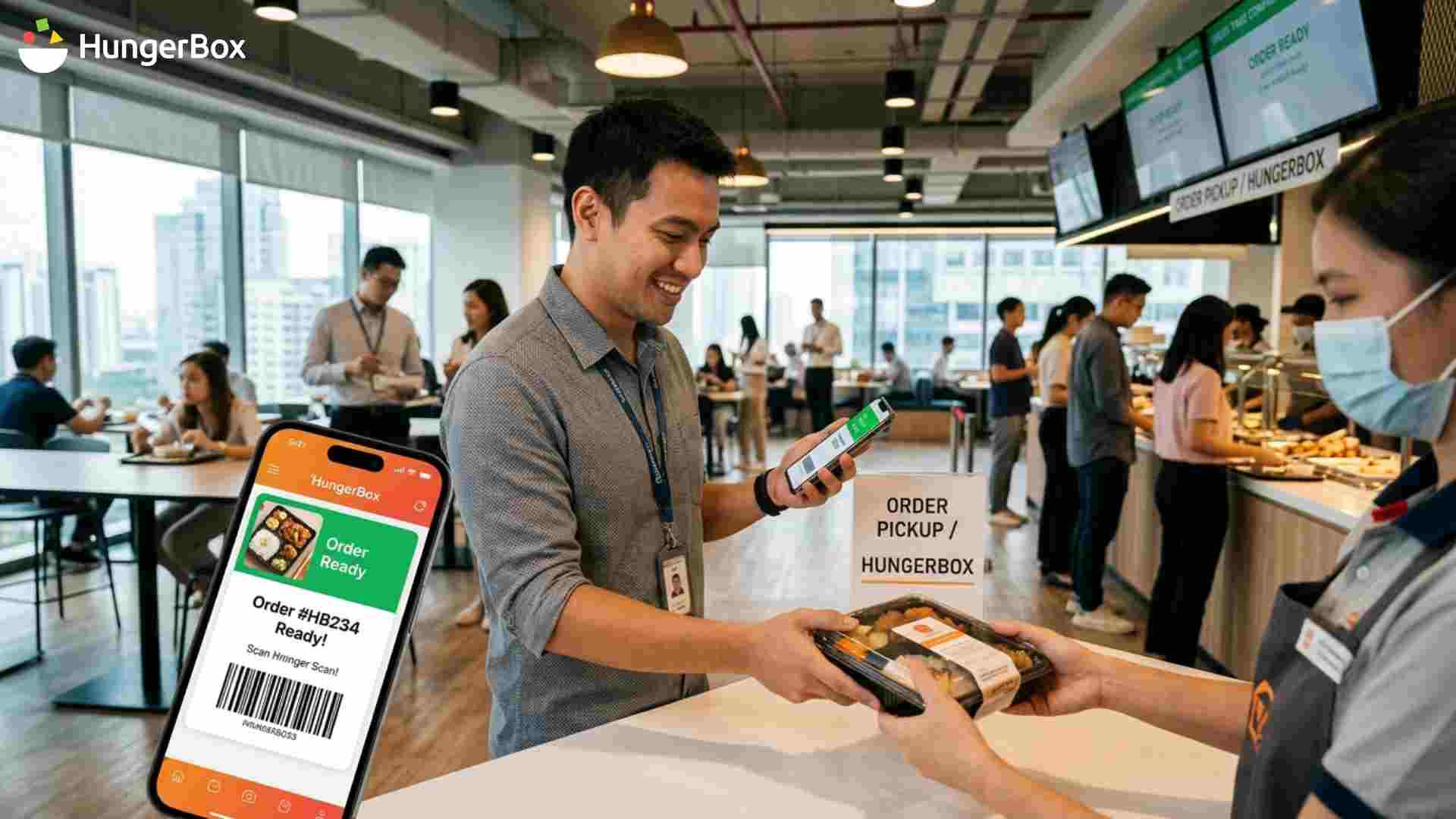
Managed Catering vs Cafeteria Technology Platform: Which Model Fits Your Company?
When it comes to running a workplace cafeteria, facility managers usually have two paths in front of them. One is managed catering, where a third party handles the food, staff, and daily running of the cafeteria. The other is a Cafeteria Technology Platform, where software takes over ordering, payments, and reporting, while you keep more control over vendors and operations.
Both models solve the same basic problem: feeding employees well without adding extra work for your team. But they work in very different ways, and picking the wrong one can cost you time, money, and a lot of employee complaints.
This guide breaks down both models in plain language. We will look at what managed catering means, what a Cafeteria Technology Platform actually does, and how the two compare on cost, control, and daily effort. By the end, you will have a clear picture of which model suits your company size, budget, and the kind of control you want over your cafeteria.
Whether you run a single office or manage cafeterias across several locations, this guide will help you make a decision based on facts, not guesswork.
Let's break it down.
H2: What Is Managed Catering?
Managed catering is a setup where a catering company takes full charge of your cafeteria. They bring their own staff, manage the kitchen, plan menus, and handle the daily running of food service. Your job as a facility manager becomes mostly about oversight, checking quality, and handling the contract.
This model works well for companies that do not want to deal with vendor coordination, staff hiring, or kitchen operations directly. You pay for a service, and the catering company delivers the meals.
H2: What Is a Cafeteria Technology Platform?
A Cafeteria Technology Platform is software that manages the operational side of a cafeteria, things like meal ordering, payments, vendor coordination, and reporting. Instead of one company running everything, you can work with multiple food vendors while the platform ties all of it together in one system.
This model gives facility managers more visibility and control. You get real-time data on sales, vendor performance, and employee feedback, and you can bring in new vendors or change menus without renegotiating an entire catering contract.
You can see how this looks in practice through HungerBox's product suite, which includes tools for ordering, kitchen management, and live reporting.
H2: How Do the Two Models Work?
Managed Catering Workflow
- A catering company is hired through a contract.
- They bring staff, plan menus, and run the kitchen.
- Facility managers check food quality and handle billing at agreed intervals.
- Any menu or staffing changes go through the catering company.
Cafeteria Technology Platform Workflow
- The platform is set up to connect with one or more food vendors.
- Employees order meals through an app, kiosk, or counter.
- Orders, payments, and feedback are tracked live on a dashboard.
- Facility managers can add vendors, adjust menus, or check performance data anytime.
The biggest difference is control. Managed catering hands over daily operations to a third party, while a Cafeteria Technology Platform keeps facility managers in charge while removing the manual work.
H2: Managed Catering vs Cafeteria Technology Platform: Key Differences
Here is a side-by-side look at how the two models compare.
[caption id="attachment_759" align="alignnone" width="760"]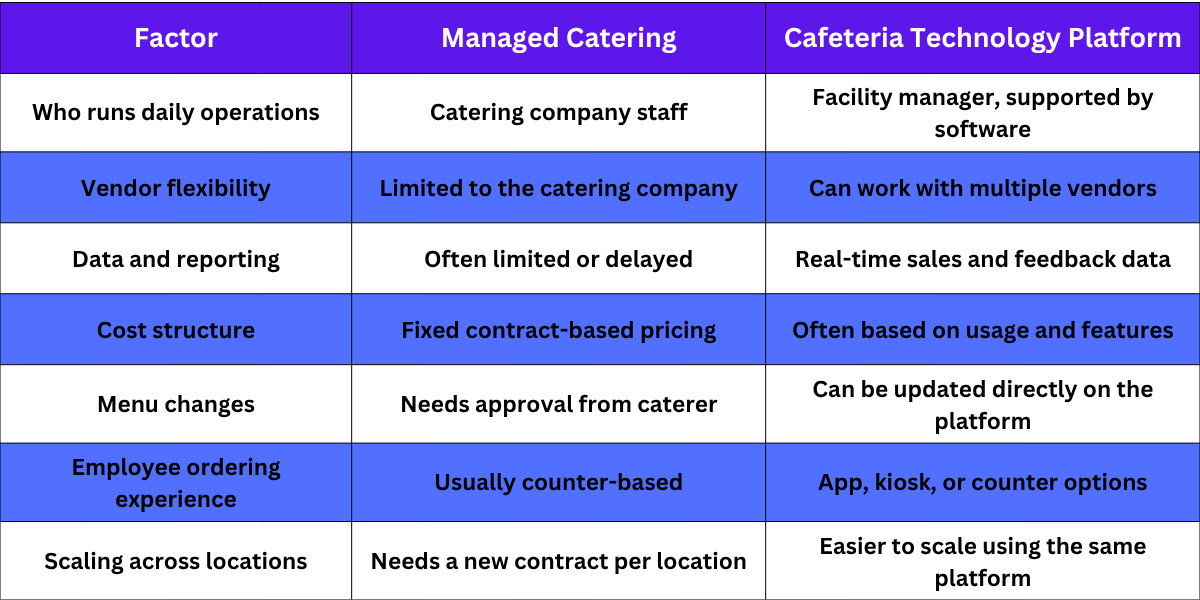 As shown above, the right choice depends on how much control and flexibility your company needs versus how much you want to hand off to a single provider.[/caption]
H2: Which Model Fits Your Company?
Choose Managed Catering If:
- You have one location and prefer a single point of contact for all food services.
- Your team does not have time to manage vendors or check daily reports.
- You are fine with a fixed contract and less flexibility on menu or vendor changes.
Choose a Cafeteria Technology Platform If:
- You manage multiple locations and need one system to track everything.
- You want real-time data on sales, vendor performance, and employee feedback.
- You prefer working with more than one food vendor instead of a single caterer.
- You want the flexibility to change menus, add vendors, or adjust benefits without renegotiating a contract.
For most growing companies, especially those with more than one office or a large employee base, a Cafeteria Technology Platform offers more control and better long-term value. It also becomes easier to spot problems early, since you are looking at real numbers instead of waiting for a caterer's report.
H2: Why Many Companies Are Moving to a Cafeteria Technology Platform
More facility managers are choosing platform-based models because they solve problems that managed catering often cannot:
- Better vendor accountability through ratings and live feedback, instead of relying on complaints.
- Faster decision-making since sales and usage data update in real time.
- More flexibility to bring in new food options, from packed meals to vending machines, without a full contract change.
- Easier scaling across offices, tech parks, or campuses using the same system.
This is exactly the gap HungerBox's platform is built to fill, giving facility managers the tools to run cafeterias with the same ease as managed catering, but with far more visibility and control.
H2: Final Thoughts
Both managed catering and a Cafeteria Technology Platform can feed your employees well. The real difference comes down to how much control, flexibility, and real-time visibility you want as a facility manager. If you run a single site and prefer to hand off daily operations, managed catering can work fine. But if you manage multiple locations, work with several vendors, or simply want better data to make decisions, a Cafeteria Technology Platform is usually the smarter long-term choice.
HungerBox offers a complete platform built for exactly this need, real-time control, flexible vendor management, and data you can actually use. If your company falls into this category, our corporate cafeteria management solutions are a good place to see how this works in practice.
Not sure which model fits your company? Schedule a call with our team, or contact us to walk through your options and find the right fit for your cafeteria.
H2: Key Takeaways
- Managed catering hands over daily cafeteria operations to a single catering company.
- A Cafeteria Technology Platform gives facility managers real-time control over ordering, vendors, and reporting.
- Managed catering works well for single-location offices that want a hands-off approach.
- A Cafeteria Technology Platform fits companies with multiple locations, several vendors, or a need for live data.
- HungerBox's platform model gives facility managers the flexibility and visibility that managed catering often lacks.
Frequestly Asked Questions

Managed catering hands over daily cafeteria operations to a single catering company. A Cafeteria Technology Platform uses software to let facility managers control ordering, vendors, and reporting themselves. The platform model offers more flexibility and real-time data.
Cost depends on your company size, number of vendors, and features you need. Managed catering often has fixed contract pricing, while platforms are usually based on usage. For companies with multiple locations, a platform can offer better long-term value.
Yes, this is one of its biggest advantages over managed catering. Facility managers can add or remove vendors without renegotiating a full contract. This gives more variety and flexibility for employees.
A Cafeteria Technology Platform is usually a better fit for multi-location companies. It lets you track all cafeterias from one dashboard instead of managing separate contracts. This makes scaling much simpler.
Consider how much control you want over vendors, menus, and daily data. If you prefer a hands-off approach, managed catering may suit you. If you want real-time visibility and flexibility, a Cafeteria Technology Platform is the stronger choice.