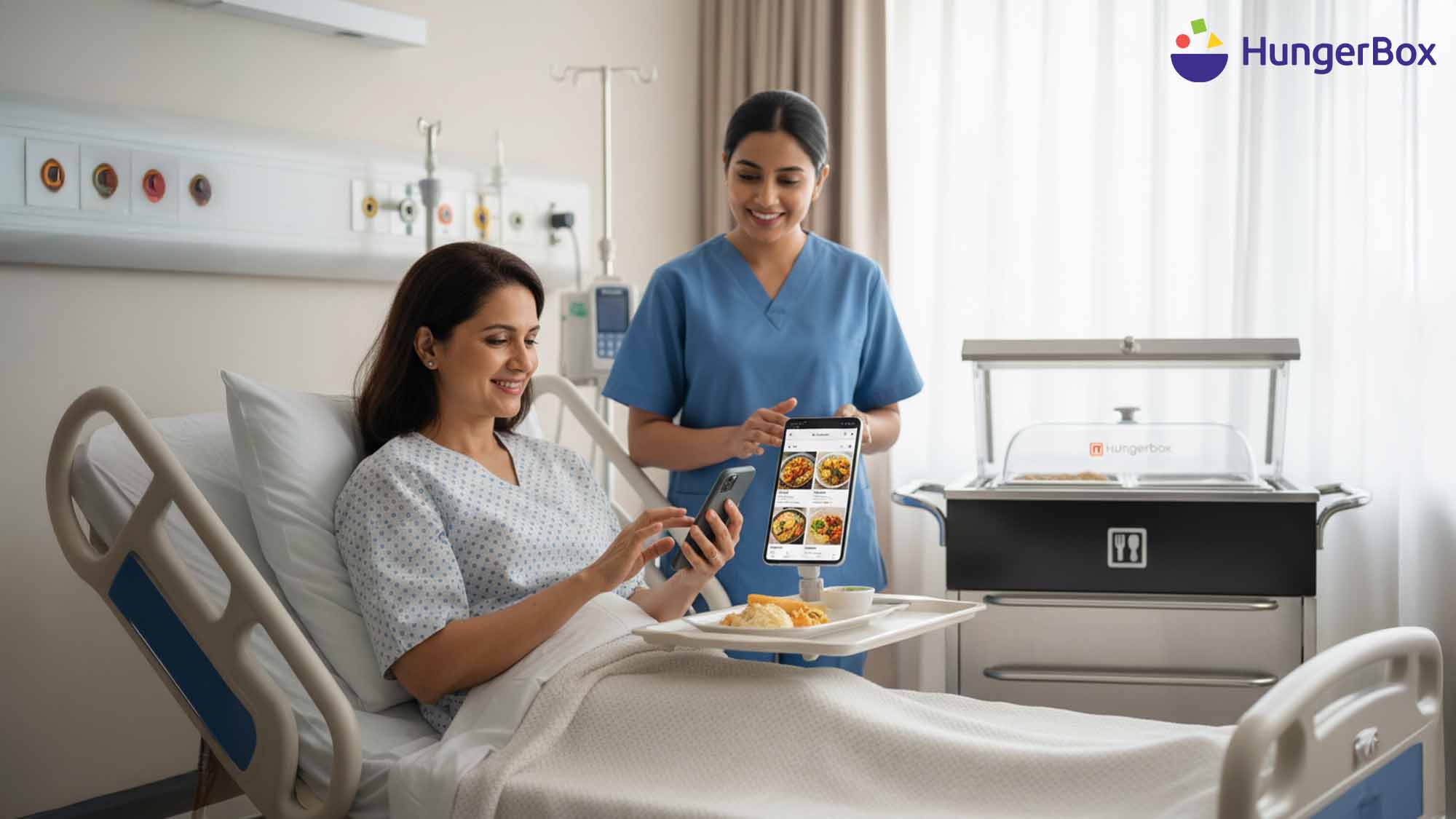
Why Is Hospital In-Room Dining Still So Complicated—and How Can Patients Order Meals More Conveniently?
For patients and attendants, hospital stays are already stressful. The last thing anyone wants is a complicated or unclear meal-ordering process. Yet, in many hospitals, the ordering mechanism for in-room dining continues to be a major frustration: long delays, repeated follow-ups, unclear menus, and no visibility into meal status.
From patients who are bedridden to attendants juggling multiple responsibilities, a poor dining workflow directly affects comfort and recovery. What should feel effortless often becomes a series of phone calls, miscommunications, and long waiting times.
Modern healthcare is evolving rapidly—but hospital dining still feels stuck in the past. Fortunately, digital solutions are changing that. Platforms like HungerBox bring a structured, transparent, and patient-friendly system to hospital dining through QR-based ordering, menu visibility, and real-time delivery updates.
This blog explores why the current system is broken—and how hospitals can redesign the in-room dining experience.
Why In-Room Dining Feels So Complicated
No Convenient Ordering Method for Patients
Most hospitals still rely on:
- Calling housekeeping or cafeteria staff
- Requesting nurses to place orders
- Filling paper slips that may get delayed or lost
For patients with limited mobility, these outdated methods create stress and dependency.
Limited Meal Access for Attendants
Attendants often:
- Don’t know meal timings
- Can’t access the full menu
- Struggle to get food delivery to the room
This results in unnecessary movement and delays.
Zero Visibility Into Meal Status
Patients have no idea:
- Whether their meal request was received
- When it will be prepared
- When delivery will happen
This uncertainty adds frustration—especially for patients who must eat at specific medical intervals.
Manual Coordination Between Dieticians, Kitchen, and Delivery Teams
A typical hospital experience involves:
- Dieticians approving meals
- Kitchen preparing them
- Staff delivering them
But these steps are disconnected. A breakdown in any one step causes:
- Wrong meals delivered
- Delayed service
- Food that doesn’t match dietary restrictions
High Communication Gaps
Patients repeat the same instructions many times:
- Less salt.
- Soft food only.
- Avoid allergens.
When details depend on verbal communication, errors are common.
Why Hospitals Must Upgrade Their In-Room Dining Experience
Patient Comfort and Recovery
Food plays a crucial role in healing. A smooth ordering mechanism for in-room dining ensures:
- Stress-free access to meals
- Timely nutrition
- A positive patient experience
Reduced Nurse Workload
Nurses often act as middlemen between patients and kitchen teams. Digital ordering removes this burden.
Improved Attendant Convenience
Family members can order easily without running to cafeterias or waiting in queues.
Better Operational Efficiency for Hospitals
A structured system improves coordination and ensures accountability.
The Solution: HungerBox Room Service Module
To address the broken ordering process, HungerBox introduces a streamlined, patient-first dining system.
QR-Code–Based Ordering From the Patient Room
Patients or attendants can simply scan a QR code placed near the bed to:
- View the live menu
- Customize selections according to dietary restrictions
- Place orders instantly
No calls. No confusion. No waiting.
Phone-Based Ordering for Patients Without Mobile Access
For patients who can’t scan a QR code, HungerBox provides a dedicated ordering line integrated into the system.
Every order—whether via QR or phone—automatically enters the same digital workflow.
Integrated Dietician Approval
This is where HungerBox stands out.
All orders pass through a dietician dashboard that:
- Validates dietary requirements
- Flags restricted items
- Approves meals before the kitchen begins preparation
This eliminates health-risk errors like serving the wrong diet.
Kitchen Management Integration
Once a dietician approves the order:
- The kitchen receives the request instantly
- Items are prepared according to the standard recipe
- The system updates dish status in real time
No lost tickets. No miscommunication.
Delivery App for Hospital Staff
The delivery team uses a mobile app that:
- Assigns delivery tasks
- Shows room number and meal type
- Tracks delivery status
- Marks orders as completed
Patients finally get full transparency.
Explore hospital dining digitization here:
How Digital Ordering Transforms the In-Room Dining Experience
Clear Menu Access for Patients and Attendants
Patients can easily browse:
- Breakfast, lunch, dinner menus
- Dietary-safe meals
- Allergen information
- Doctor-approved options
Real-Time Meal Tracking
Patients know exactly:
- When their order is accepted
- When approval happens
- When the meal is being prepared
- When it’s out for delivery
No more guessing or repeated follow-ups.
Faster, Error-Free Meal Delivery
Digitizing the entire chain reduces:
- Delays
- Incorrect meals
- Missed dietary instructions
Better Feedback Loop
Patients can rate:
- Food quality
- Delivery speed
- Portion sizes
Hospitals gain actionable insights instantly.
Improved Diet Compliance
Dieticians have full oversight, ensuring every meal aligns with each patient’s nutritional needs.
Benefits for Hospitals Beyond Patient Experience
Optimized Operations
Digital workflows reduce manual interventions and errors.
Reduced Food Wastage
The kitchen prepares meals based on accurate digital requests.
Better Coordination Between Teams
Dieticians, kitchen staff, and delivery teams operate in perfect sync.
Higher Patient Satisfaction Scores
Better dining = better overall hospital experience.
Transparent Records for Compliance
Every meal is logged with:
- Time of request
- Approval details
- Preparation history
- Delivery timestamps
This helps hospitals meet quality standards effortlessly.
Why Patients Prefer Digital In-Room Dining
Ease of Use
- A QR code is all they need.
Convenience
- No more calling, waiting, or repeating instructions.
Personalization
- Orders can be tailored to preferences and medical requirements.
Predictability
- Live tracking reduces anxiety around meal timing.
Safety
- Dietician oversight ensures every meal is medically appropriate.
Final Thoughts
Hospital stays are hard enough. Patients deserve a stress-free, transparent, and convenient dining experience. Outdated manual systems make the ordering mechanism for in-room dining unnecessarily complicated—leading to delays, confusion, and errors.
With the HungerBox Room Service Module, hospitals can:
- Enable QR and phone-based ordering
- Streamline dietician approval
- Digitize kitchen operations
- Improve delivery speed and accuracy
It’s a complete, end-to-end solution designed to improve both patient comfort and hospital efficiency.
Modern hospitals are adopting digital care—dining should be no exception.
Transform In-Room Hospital Dining Today
Frequestly Asked Questions

Patients often face long delays, unclear menus, and repeated follow-ups because most hospitals still depend on phone calls or manual processes. This lack of transparency leads to uncertainty about meal status, delivery time, and dietary accuracy.
Digital ordering systems—especially QR-based menus—allow patients and attendants to view live menus, customize meals, and order instantly from their room. This removes the need for calls, reduces dependency on nurses, and speeds up delivery.
Yes. With platforms like HungerBox, every meal request passes through a dietician approval workflow. Restricted items are flagged automatically, ensuring patients receive only medically safe, diet-compliant meals.
HungerBox integrates ordering, dietician approval, kitchen preparation, and delivery into a single connected system. This eliminates miscommunication, prevents errors like wrong meals, and provides real-time tracking for patients and attendants.
Absolutely. Digital systems reduce the workload on nurses, streamline kitchen operations, minimize errors, cut food wastage, and shorten meal delivery cycles. Hospitals achieve better efficiency while improving the patient experience.